

GHL ORIGINALS | THEN → NOW → NEXT | ISSUE 001
From waiting for Christmas 1983 to the computers of today, revisiting the little machine that started my obsession with technology.
THEN: Christmas 1983. A Computer That Nearly Never Arrived.
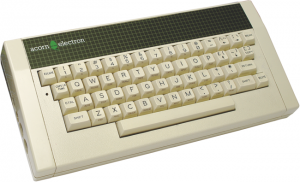
Back in 2021, I wrote an article about the Acorn Electron, the first computer I ever owned.
I was recently going through the old Geeks Have Landed archives and came across it again. It got me thinking about just how far technology has come since that little beige machine arrived in my life.
Let’s rewind to 1983.
While most of my friends were interested in the ZX Spectrum or Commodore 64, I’d always been fascinated by the BBC Micro. The problem was that owning one wasn’t particularly realistic. At nearly £400, it was a substantial amount of money.
Then Acorn announced the Electron. A smaller, cheaper alternative that brought BBC BASIC into the home for £199.
I wanted one.
Unfortunately, so did just about everybody else.
Acorn ran into manufacturing problems with its custom ULA chip, and production couldn’t keep up with demand in the run-up to Christmas. I still remember visiting the computer shop to see whether mine had arrived.
There was no online order tracking, no delivery notification and certainly no text message telling you your parcel was eight stops away.
You simply went into the shop and asked.
Fortunately, I was one of the lucky ones whose Electron arrived in time for Christmas.
And that was it. I was hooked.
The wonderful frustration of cassette loading
If you grew up with computers in the 1980s, you’ll remember loading software from cassette tapes.
Getting the volume right on the cassette player was practically a skill in itself.
There was nothing quite like sitting through several minutes of screeching noises and flashing colours, only for the game to fail to load.
So you’d rewind the tape, adjust the volume slightly and try again.
And we call a five-second loading screen slow today!
I spent plenty of time experimenting with BASIC, but I also remember being rather fond of Chuckie Egg.
Climbing ladders, collecting eggs and avoiding angry birds. Simple stuff by today’s standards, but brilliant fun.
Looking back, though, I think the Electron gave me something more valuable than an introduction to computer games.
It made me curious about how technology worked.
And that curiosity never really disappeared.
NOW: 2026. Whatever Happened to Acorn?
Jump forward 43 years and the Acorn Electron feels like a machine from another world.
It had 32KB of RAM.
Not 32GB. Not even 32MB.
32 kilobytes.
Today, the device in your pocket can stream films, take professional-looking photographs, navigate the planet, play incredibly sophisticated games and run AI-powered features.
Yet there’s something fascinating about what happened to the company behind that original little computer.
Acorn didn’t simply disappear into computing history.
During the mid-1980s, its engineers began developing a new processor architecture known as ARM, initially for a later generation of Acorn computers.
That technology eventually became one of the most important developments in modern computing.
ARM-based designs now underpin enormous parts of the technology industry, particularly smartphones, tablets and increasingly powerful personal computers.
The Electron itself didn’t contain an ARM processor, of course, but it belonged to the same extraordinary British computing story.
In fact, there’s a good chance you’re reading this article on a device powered by technology descended from Acorn’s later work.
Not a bad legacy for a company many people associate with school computers and cassette tapes.
The Electron isn’t quite finished, either.
Thanks to retro-computing enthusiasts, you can still enjoy the Electron today.
Original machines are restored, old games are preserved, and emulators allow us to experience these computers without needing to track down 40-year-old hardware.
Even Chuckie Egg lives on.
As for my own Electron, the last time I wrote about it, I mentioned that it was somewhere in the loft.
I really should go looking for it.
Which brings me to the final part of this little journey.
NEXT: From BASIC to AI. Have We Come Full Circle?
Something I’ve been thinking about recently is how artificial intelligence is changing our relationship with computers.
When I switched on my Electron in 1983, I was presented with a BASIC prompt.
If I wanted it to do something, I needed to learn enough of its language to tell it what to do.
Today, I can open ChatGPT or Claude, explain an idea in ordinary English and ask it to help me create something.
The technology couldn’t be more different, but there’s a familiar feeling to it.
Experimenting. Trying something. Getting it wrong. Changing a few things and trying again.
That was half the fun of owning a home computer in the 1980s.
Perhaps AI is bringing some of that spirit back, only this time you don’t necessarily need to learn a programming language to get started.
Which has given me an idea.
Could I use modern AI to recreate one of those first BASIC programmes I wrote on the Electron?
Or perhaps take an original Electron game and explore how it could be rebuilt using modern tools?
I rather like the thought of using technology from 2026 to revisit something that fascinated me in 1983.
That might just become a future Geeks Have Landed experiment.
One last thing…
If you owned a home computer in the 1980s, you’ll probably remember the excitement of discovering something new it could do.
The Acorn Electron may have had just 32KB of RAM, but for me, it opened up an entire world.
And more than four decades later, I’m still exploring it.
Technology has changed. The curiosity hasn’t.
FROM THE GHL ARCHIVE
This feature revisits my original article, The Acorn Electron, published on Geeks Have Landed in 2021.
Over to you: What was your first computer? And, more importantly, have you still got it hidden away somewhere?
